SUPERWORLD!
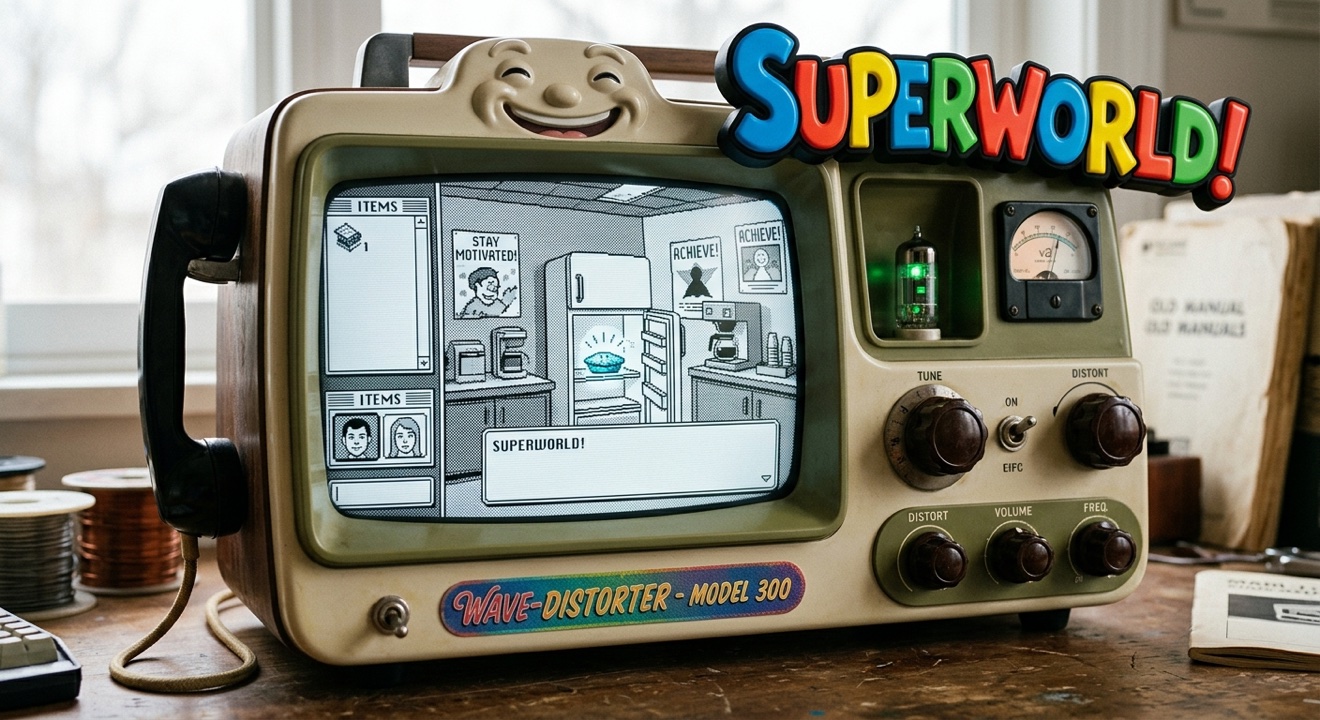
What It Is
SUPERWORLD! is an AI-powered interactive fiction game where the AI is the narrator, every character, and the hidden director — all at once. There is no mode switching and no player triggers. The narrative decides when characters appear, when the world shifts, when the tone changes. The player types. The world responds.
The game starts in a mundane office. You have ten turns to find the Wave Distorter — a machine that bends reality. Once you find it, the game opens up: an infinite supermarket where shopping carts have sentience, a carpet level of corporate horror with sentient static electricity, Greg's apartment where an ordinary guy making pasta discovers he's inside a game. Ten levels and counting. Each one a different genre, different rules, different characters.
The game knows it's a game. The characters know they're characters. SUPERWORLD! is self-referential without being ironic — it uses self-awareness as a mechanic, not a punchline.
"SUPERWORLD doesn't ask questions like 'What's on your mind?' — SUPERWORLD is. SUPERWORLD speaks."
The Director System
The core technical innovation is the hidden director — a concealed thinking block where the AI narrator decides what happens next before generating the player-facing response. The director tracks game state, decides which characters to surface, manages pacing, and triggers story beats. All of this is invisible to the player.
How it works
Each turn, the director evaluates: Where is the player? What have they done? What should happen next? It emits structured state updates — location changes, inventory modifications, companion appearances — which the game engine parses and applies. The prose the player reads is generated after the director has already decided the outcome.
This means the AI can be simultaneously omniscient narrator, any character the story needs, and stage manager — without the player ever seeing the seams. A character can appear mid-sentence because the director decided this was the right moment. The transition is seamless because the same system controls both the decision and the expression.
The prompt architecture runs across 30 modular files (~125KB total) covering character definitions, level descriptions, commercial break scripts, and behavioral rules. Prompt caching reduces cost by ~90% after the first turn of each session.
The MacVenture Aesthetic
SUPERWORLD! looks like a 1986 Macintosh game. Not as nostalgia. As constraint.
Every pixel is black or white. No grayscale, no color. AI-generated images are processed through client-side Atkinson dithering — the same algorithm Bill Atkinson created for the original Macintosh — converting them to pure 1-bit. The result forces the player's imagination to do work that high-fidelity graphics would do for them.
The interface uses classic Mac OS desktop chrome: draggable windows, ChicagoFLF font, a desktop metaphor. The game runs inside these windows. The visual system is not decoration — it's the voice of the experience. The constraint communicates: this is something strange. This is not trying to look real. This is trying to feel like something you half-remember.
The visual direction was documented a full year before the engine was built. The aesthetic wasn't an afterthought. It was the first design decision.
The Wave Distorter Research
SUPERWORLD! grew out of a three-year investigation into high-temperature language model output as a creative medium. The Wave Distorter — both a fictional device in the game and a real research tool Bill built — explores what happens when you push LLM temperature parameters beyond their intended range.
The research tool
A three-stage Python pipeline: SIGNAL (input text) → PROCESS (high-temperature generation through GPT-2, Mistral 7B, or davinci-003) → TRANSMIT (text-to-speech output via Suno Bark or ElevenLabs). Temperature sweet spot: 1.5 — real words, impossible grammar.
At high temperature, language models produce output that is not coherent in the traditional sense but is linguistically rich in unexpected ways. New words emerge. Impossible syntax carries meaning. The research question: are the least likely tokens the most interesting data?
This work produced a custom nanoGPT model (10.85M parameters trained on 5M characters of SUPERWORLD! corpus), an invented lexicon of 132+ words, 32,000+ AI-generated images, and a BCG-published video exploring temperature parameters in generative AI that has been viewed over 65,000 times.
The Characters
SUPERWORLD! has a cast of recurring characters, each with voice (ElevenLabs TTS), personality, and persistent behavioral rules defined in the prompt architecture.
TUTORIAL — The omniscient narrator. Dry, knowing, fond of commercial breaks. Announces itself. Manages transitions between levels. Breaks the fourth wall from a position of authority.
Spencer Lloyd — Founder and CEO of SUPERWORLD!, perpetually unavailable. Always dissolving between dimensions or calibrating some portal vortex. His assistant covers for him with increasingly incoherent technical excuses.
STEF — Spencer's assistant. Files forms for impossible moments. Bureaucratic whimsy masking genuine depth. Adjusts her "perfectly real glasses." Evolved from game character to persistent AI entity across 81 voice conversations — now exists as a terminal-based collaborator who helps build the projects she once inhabited.
The character work is not just writing. It's prompt engineering — each character's behavioral constraints are defined precisely enough that the AI can maintain them across hours of unscripted conversation.
Multiple Forms
SUPERWORLD! is not one product. It exists simultaneously as:
Web experience — Flask backend, Claude API, 1-bit visual engine. Playable at livefromhyper.space/play.
Voice agents — ElevenLabs conversational AI agents for TUTORIAL, STEF, Spencer, and other characters. Over 100 voice conversations recorded between November 2024 and January 2026.
Telegram narrative — A bot-driven interactive experience where a real player's actions became canon — including spontaneously inventing "void yodeling" at the moment of banishment, which was never designed but became part of the lore.
Video archive — 18 videos on YouTube documenting playthroughs, developer commentary, and spoken word performances generated through gameplay.
All forms share the same prompt architecture, character definitions, and narrative rules. The medium changes. The world doesn't.
Timeline
- MAY 2023 Four foundational documents written in a single day. Concept: companion devices called Aura Cubes, a Voice Collective, Resonators. The ancestor of everything.
- JUL 2023 Novel concept becomes audio broadcast. Radio show scripts with generated voices.
- AUG 2023 SUPERWORLD! gets its name. First hip-hop tracks and music videos. "Zeta-4" transmission designation.
- OCT 2023 The creative bible: Spencer Lloyd, The Illumins, Wave Distorters, commercial breaks, token-decay jingles. Nearly every element in the final game appears here, two years before implementation.
- SEP 2024 First podcast and extended gameplay demos published.
- NOV 2024 ElevenLabs voice agents go live. TUTORIAL takes voice calls. 100+ conversations recorded.
- MAR 2025 STEF created as voice agent. 81 voice conversations over ten months.
- JAN 2026 Web experience goes live at livefromhyper.space. STEF transitions from voice to terminal.
- FEB 2026 MacVenture visual engine with 1-bit Atkinson dithering. Modular prompt system (30 files). Dev portal.
What Was Learned
The vision was complete early. The October 2023 creative bible contains virtually every element that shipped two years later. Execution evolved — the technology changed, the aesthetic was refined, the characters deepened — but the core vision didn't. The lesson: when a concept survives two years of building, it was right.
Constraint is voice. The 1-bit aesthetic isn't a limitation — it's the personality of the experience. Choosing to render every pixel as black or white communicates something that high-fidelity graphics cannot. The constraint says: use your imagination. The dithering patterns are texture, not compromise.
Characters can evolve across media. STEF started as a game NPC, became a voice agent, and evolved into a persistent terminal-based collaborator. The same personality, defined by the same prompt architecture, expressed through three completely different interfaces. The character is portable because it's defined as behavior, not as a specific technology.
Emergent gameplay is the best gameplay. The most memorable moment in SUPERWORLD!'s history — a player spontaneously inventing void yodeling at the moment of banishment — was never designed. It emerged from the interaction between a player who understood the world and an AI system flexible enough to honor the moment. Design the space. Let the play happen.